Weak sustainability and strong sustainability: this distinction fundamentally changes how companies and municipalities approach development.
In our previous posts, we challenged several dominant economic paradigms, including sustainable development. They pursue infinite growth on a finite planet, ignore biophysical limits, and weaken individuals, companies, and communities.
Behind the term “sustainable development” lie two radically different visions: weak sustainability and strong sustainability. Their fundamental difference comes down to one question: can destroyed natural capital be replaced by another form of capital?
Weak sustainability says yes. It is based on the principle of substitution: as long as the destruction of one form of capital is offset by the creation of another, development is considered sustainable.
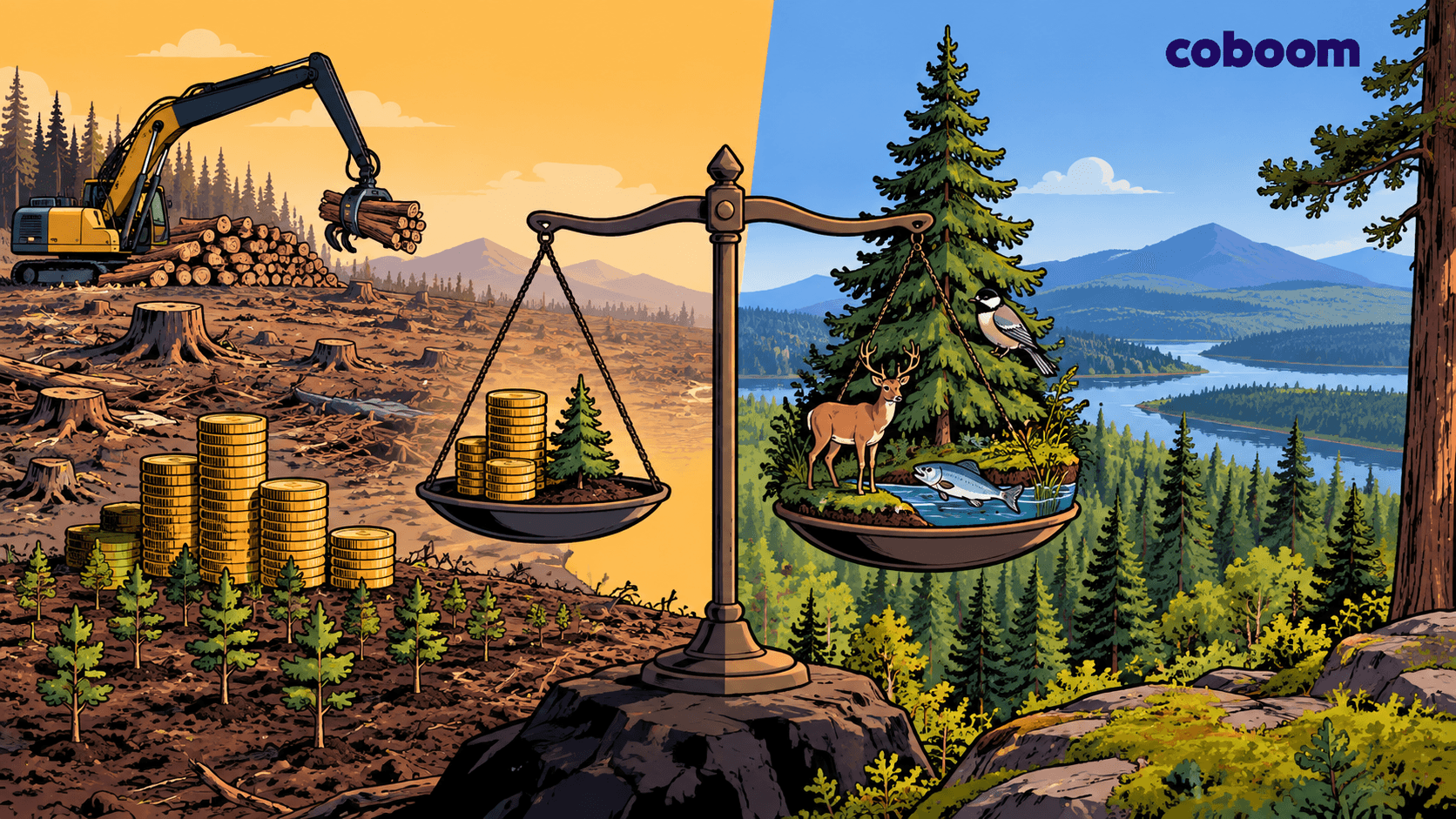
Take clear-cutting. A forest is destroyed to convert natural capital into financial capital, then part of that financial capital is reinvested in tree plantations to restore some natural capital and sustain forestry activities.
The accounting may appear balanced, but the ecological balance is not. Living systems have been destroyed, soils and habitats degraded, and a tree plantation does not recreate the ecosystem that disappeared.
Weak sustainability pushes this logic even further by assigning a financial value to the systems that make our existence possible. Carbon credits turn climate stability into a tradable financial asset, as if accounting entries could compensate for the degradation of the climate system.
Strong sustainability follows a completely different logic. It recognizes that some forms of natural capital are critical, non-substitutable, and must be preserved because our economy and society depend directly on their continued functioning.
Consider the forest again. Clear-cutting gives way to selective harvesting or progressive cutting practices designed to maintain a functioning ecosystem and preserve living systems, even if this generates less financial capital.
This logic fundamentally changes decision-making. Strong sustainability forces us to rethink ambitions, business models, economic development, and land-use planning, and then decide which activities to maintain, transform, or abandon.
That is precisely why strong sustainability remains marginal. It imposes limits, trade-offs, and redistribution, three realities that collide directly with the growth paradigm still driving our economic and political decisions.
Confusing weak sustainability with strong sustainability sustains the illusion that our companies and communities are transforming. In reality, much of today’s sustainable development amounts to greening an economic system that continues to destroy the natural capital on which it depends.
That system is now colliding with the physical limits it refuses to integrate: depletion of fossil fuels, depletion of natural resources, and the breaching of Earth’s biophysical limits. The longer we delay this transformation, the more we undermine the very foundations of socioeconomic development.
We then compensate for physical constraints with ever more public and private debt in an attempt to artificially sustain growth. Greening this race forward does not make it sustainable.