As the economy slows and artificial intelligence spreads at breakneck speed, a wave of layoffs is hitting white-collar workers. The first roles to disappear are often those whose real usefulness is difficult to explain, sometimes described as “bullshit jobs,” along with management positions devoted mainly to moving information up and down the hierarchy.
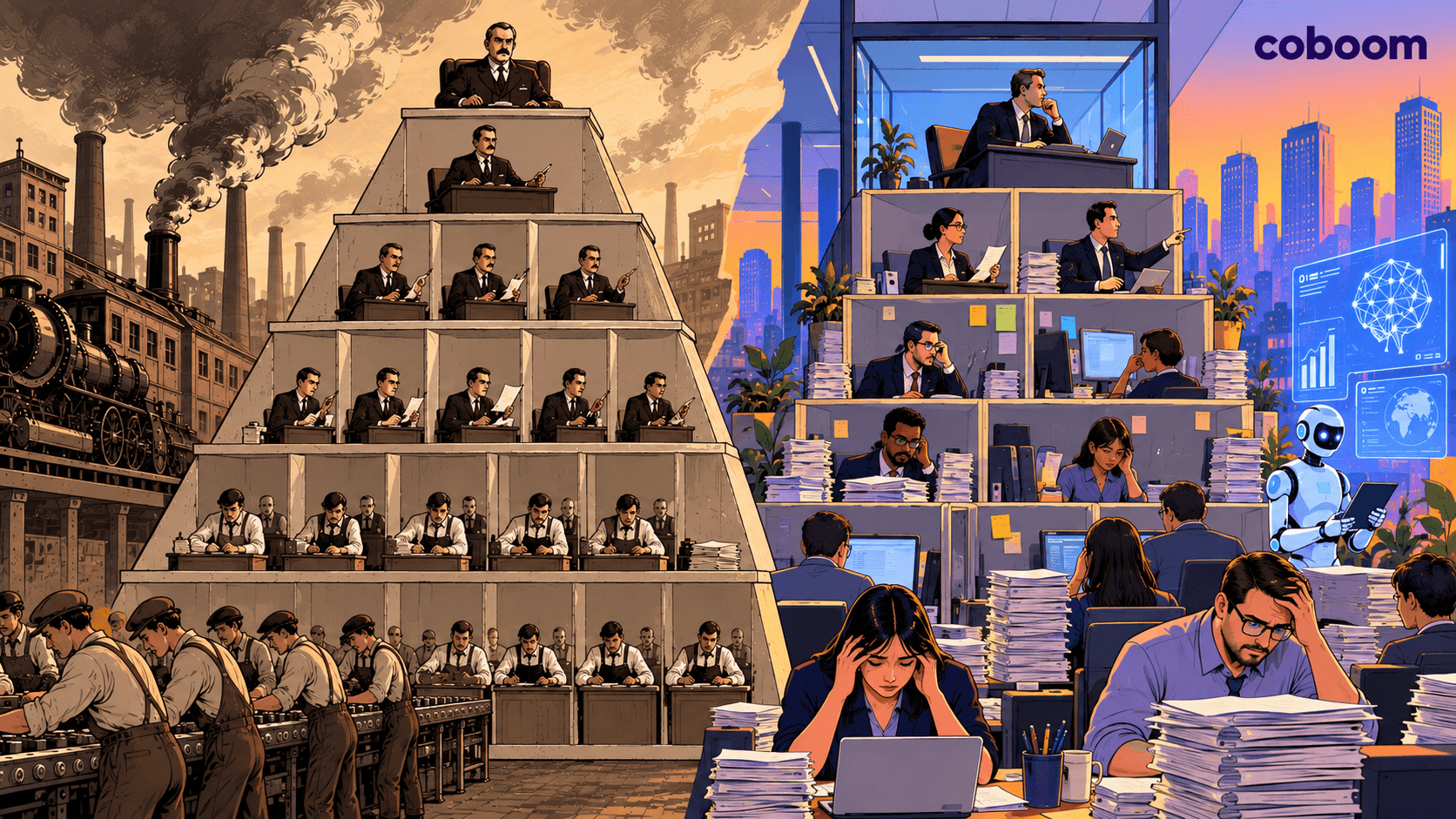
Most mid-sized and large companies still operate with an organizational architecture inherited from the Second Industrial Revolution. The hierarchical pyramid became dominant between 1880 and 1920 as a way to organize large factories, standardize work, and control thousands of people in a relatively stable industrial environment.
At Coboom, we sometimes call it the ego structure, or the game of little boxes. Every new CEO redraws the org chart, moves a few boxes around, adds or removes layers, and leaves a personal mark while the underlying architecture remains almost unchanged after more than a century.
Frederick Taylor, Henry Ford, and Henri Fayol helped shape this mechanical view of the company. Work is broken down, controlled, and optimized, while people become interchangeable “resources” inside a giant organizational machine.
The job description becomes the technical specification for that resource, while the employee handbook becomes its operating manual. The term “human resources” perfectly captures this industrial mindset: people are treated as resources to be planned, assigned, measured, and optimized.
It should therefore come as no surprise that so many people struggle to find meaning in their work. A company that treats people like resources eventually gets resource-like behavior in return: execute, wait for instructions, protect your territory, and avoid taking risks.
The problem gets worse as companies grow. Frederick Brooks showed as early as the 1970s that adding more people dramatically increases communication and coordination requirements, to the point where adding resources can actually slow the work down instead of speeding it up.
The math is simple. In a group of n people, the number of potential relationships can reach n(n − 1) / 2: three people generate three possible relationships, while ten generate forty-five.
As the company grows, more and more energy is consumed explaining, coordinating, transmitting, approving, and controlling. Complexity grows much faster than productive capacity.
Roger Mucchielli argued as early as the 1960s that an effective team rarely exceeds five to seven people. Robin Dunbar later showed that humans can maintain roughly 150 stable social relationships, and Coboom uses both reference points to rethink organizational design around smaller, more autonomous, interconnected teams.
Artificial intelligence is now making the absurdity of the pyramid impossible to ignore. AI accelerates access to information, automates analysis, and eliminates part of the administrative work that once justified multiple layers of middle management.
Injecting AI into a bureaucratic pyramid does not transform the company. It mainly allows a structure designed for early-20th-century industry to move information faster through bottlenecks it created itself.
Mid-sized and large companies now operate in a digital, interconnected, accelerated, and unpredictable world. Yet they continue to organize themselves according to principles designed for the giant factories of the Second Industrial Revolution.
AI will not make these structures smarter. It will simply make their obsolescence impossible to hide.