In 1965, American chemist and physicist Gordon Moore, who would later co-found Intel, made an observation that would reshape the global economy. The number of transistors on an integrated circuit was doubling roughly every two years, driving a spectacular increase in computing power. That dynamic, later known as Moore’s Law, would propel the digital economy for decades.
Sixty years later, artificial intelligence is following an even faster trajectory. A 2025 study by METR, an institute specializing in the evaluation of frontier AI systems, estimated that the length of tasks AI systems can complete autonomously is currently doubling roughly every seven months. Some projections even suggest that pace could reach a doubling every four months by the end of 2026.
That acceleration is fuelling predictions of rapid organizational transformation and massive job losses. But those forecasts often confuse two radically different speeds: the speed of technological development and the speed at which companies can actually adopt it.
The history of general-purpose technologies is clear. The Internet, smartphones, and now AI are typically adopted first by individuals, then by small businesses, followed by mid-sized and large companies, and finally by government institutions.
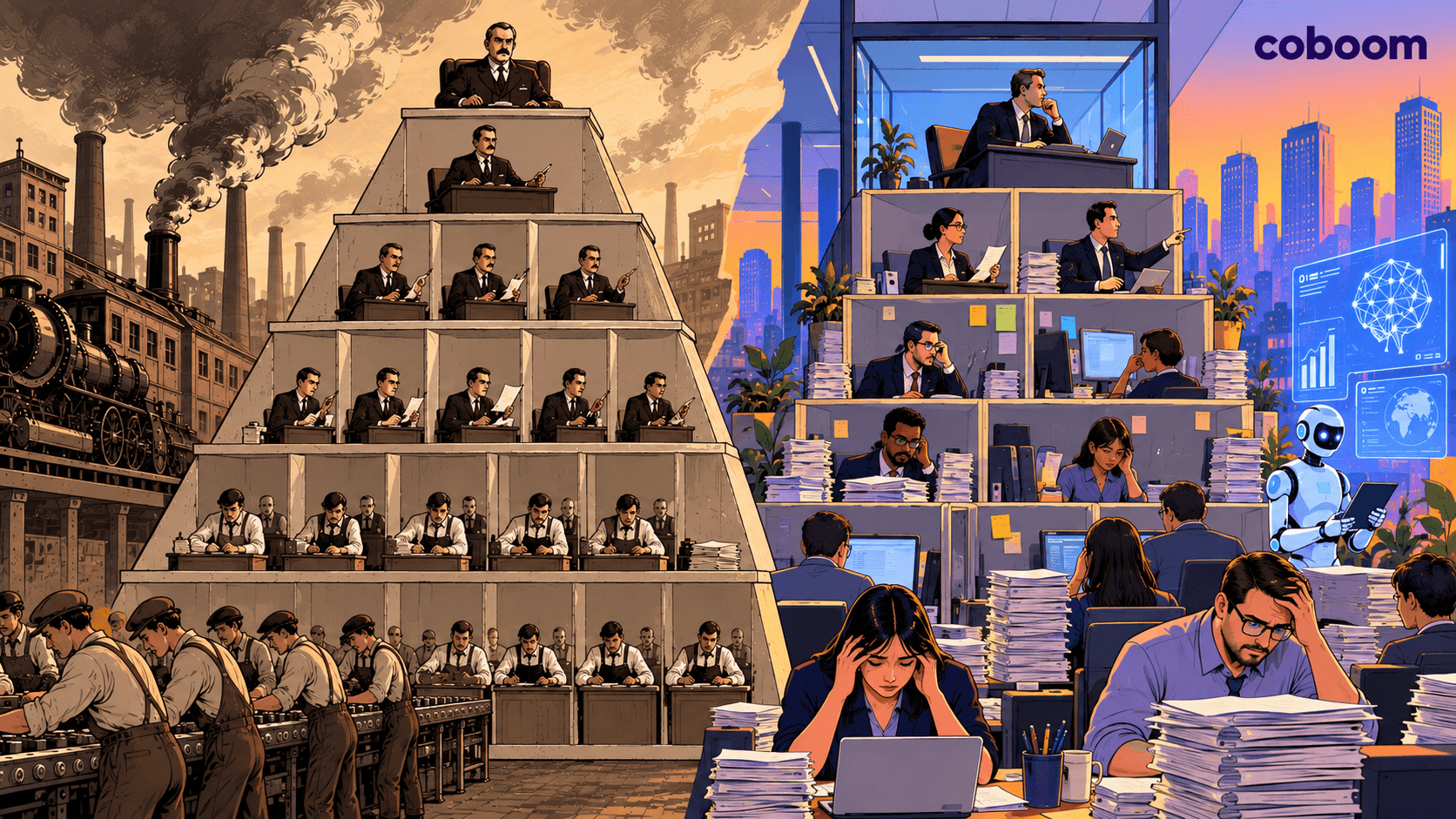
The larger a company becomes, the more people, systems, rules, processes, and dependencies it accumulates. Every new technology must then make its way through silos, governance, information systems, regulatory constraints, cybersecurity, budgets, and internal power structures before it can produce meaningful results.
Small businesses have a major advantage here. A few people can test a tool, change the way they work, and learn within a matter of weeks, almost like a commando unit.
Mid-sized and large companies carry much heavier organizational baggage. Their hierarchical silos, complex information systems, and IT functions were designed to preserve stability, reduce risk, and protect what already exists, while AI requires experimentation, flexibility, and speed of execution.
That is why the pace of AI progress will not automatically translate into an equally rapid transformation of work. Technological capabilities may double every few months while companies take years to change their processes, structures, systems, and skills.
At Coboom, we therefore make a clear distinction between technological potential and an organization’s ability to capture it. Competitive advantage will belong less to companies with access to the best AI models than to those capable of rapidly redesigning how work gets done around these new tools.
AI is progressing at an exponential pace. Companies, however, still move at the speed of the people, structures, and systems they have accumulated over decades.
And another constraint is already catching up with this technological acceleration: the energy required to power the data centers that make it possible.