Since the first Industrial Revolution more than two centuries ago, businesses have been trying to produce more with less human labor. Across three industrial revolutions, that pursuit mainly meant replacing physical work with machines that became increasingly powerful, faster, and more productive.
Artificial intelligence marks a new threshold. For the first time at this scale, it is no longer just manual labor that can be automated, but a growing share of intellectual work: writing, analyzing, coding, translating, designing, researching, and advising.
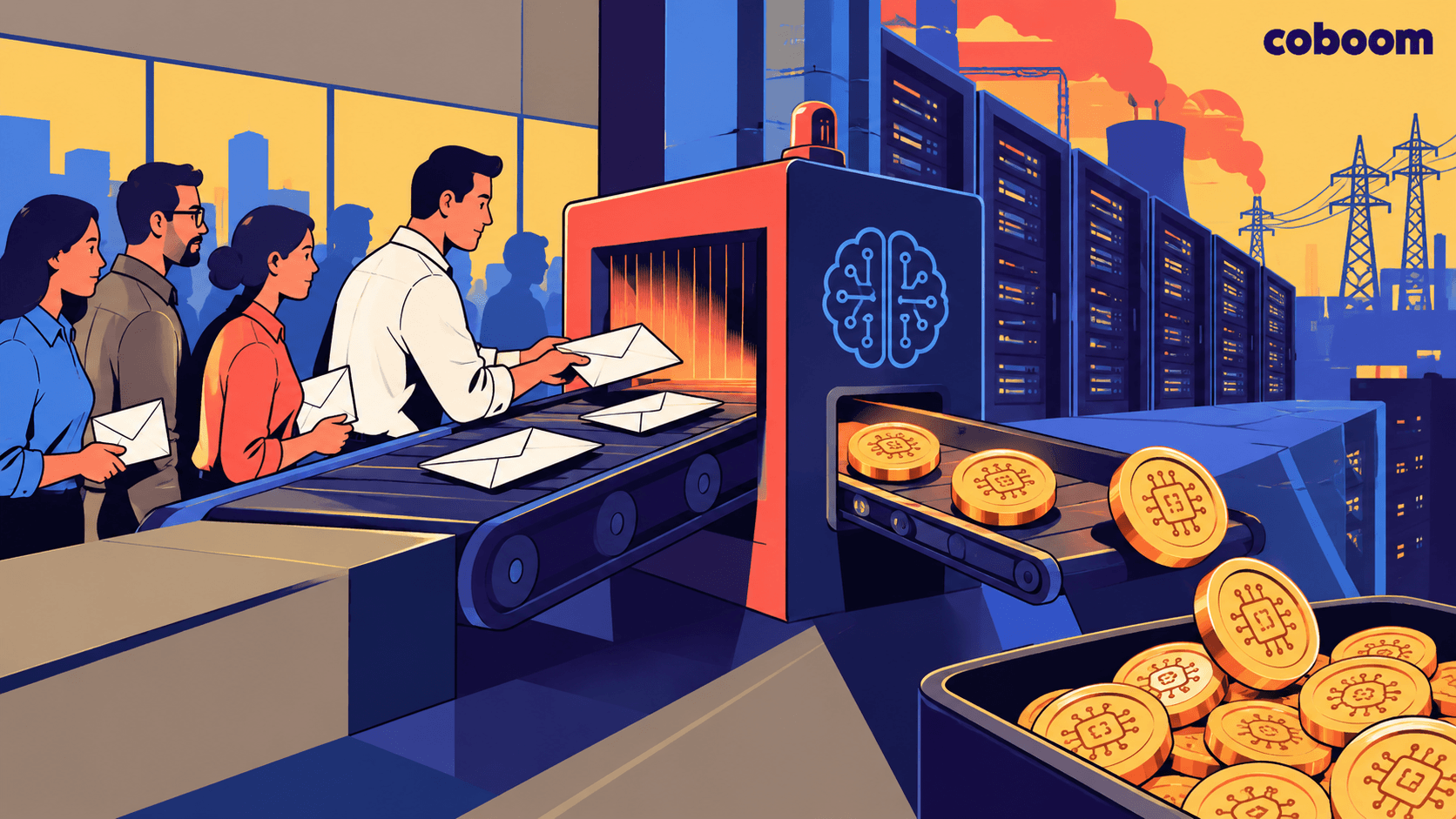
This new economy relies in part on a unit that is still largely unknown to the public: the token. AI models break information into tokens in order to process it, and every question, document analyzed, and response generated consumes a certain number of them.
For many AI services, tokens are also becoming a unit of billing. For decades, businesses bought hours of human labor; they are now beginning to replace some of those hours with computing power priced according to the volume of information processed.
But tokens are anything but immaterial. Behind them are semiconductors, servers, data centers, power grids, cooling systems, metals, water, and enormous amounts of energy.
AI therefore depends on a massive industrial infrastructure whose rapid expansion is placing growing pressure on our energy and material systems. Part of that energy still comes from coal in China and natural gas in the United States. In other words, some of the most advanced technologies of the 21st century still depend on fuels formed from organisms that captured solar energy millions of years ago.
The disruption, however, goes far beyond energy. When a task once performed by a salaried employee is transferred to an AI model, part of the money that once paid for human labor is redirected toward those who own the models, semiconductors, cloud infrastructure, and data centers.
We are gradually moving from an economy that pays for human hours to one that buys computing power from a relatively small number of global players. The question is therefore not only how many jobs will be transformed or automated, but also who will own these new intellectual machines and who will capture the productivity gains they generate.
For two centuries, automation mainly replaced muscle with machines. It is now beginning to replace hours of intellectual work with tokens and, without mechanisms to redistribute productivity gains, this shift could significantly accelerate the concentration of wealth.
The AI revolution will therefore not be purely technological. It will also be economic and social, and the way its gains are distributed will determine whether AI broadly enriches society or transfers even more wealth from the middle class to those who own the infrastructure that powers it.