British historian Arnold Toynbee, who studied the decline of civilizations, and American billionaire investor Ray Dalio, who studies the rise and fall of empires, arrive at a similar conclusion. Societies rise, plateau, and eventually decline.
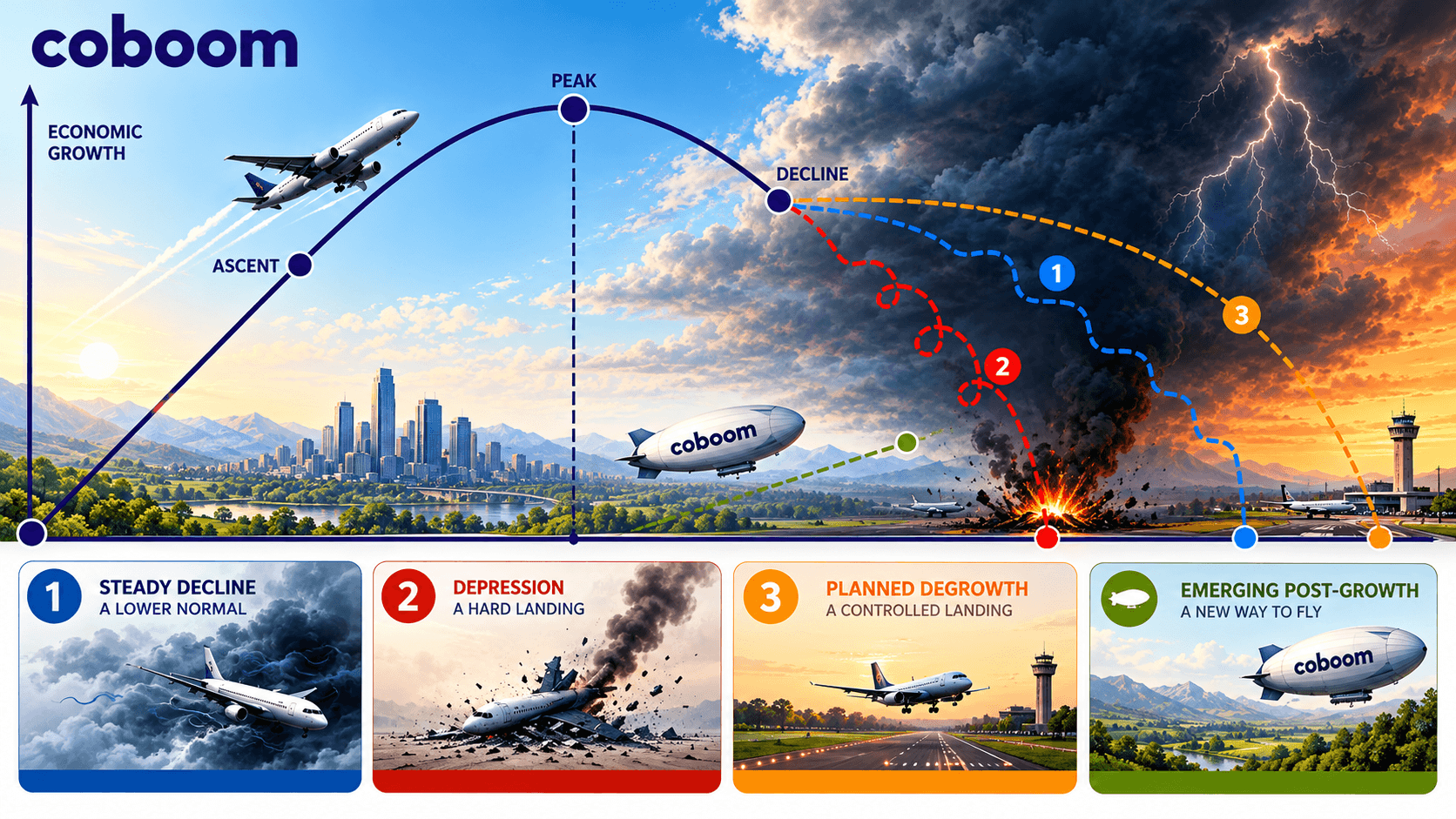
Like an airplane powered by the Industrial Revolution, the Western economy climbed for two centuries on the back of abundant, cheap energy. The peak of U.S. conventional oil production in 1970, followed by the oil shocks of 1973 and 1979, delivered a brutal reminder of a simple reality: no airplane can stay in the air forever.
The pilot now faces three possible flight paths. The first two stubbornly try to fly higher, faster, and farther. The third chooses to land before the crash.
In the first path, the aircraft hits one patch of turbulence after another and each time stabilizes at a slightly lower altitude. Passengers gradually lose comfort, but eventually get used to it. This is the shifting baseline syndrome: we normalize the steady deterioration of our natural and built environments, along with our standard of living. This is the path we are already on.
In the second path, the airplane enters a storm it cannot fly through. It stalls and crashes, as economies did during the Great Depression of the 1930s. This scenario becomes increasingly likely if we persist with Business as Usual.
The third path requires changing course. The pilot accepts that the aircraft will not travel as far and prepares for a controlled landing to protect the passengers. This is the path of degrowth advocated by Yves-Marie Abraham, professor at HEC Montréal. It means deliberately and fairly reducing production and consumption to bring the economy back to a scale compatible with ecological limits and human needs.
At Coboom, we actually fund the Coboom Degrowth Scholarship at HEC Montréal. We also believe there is little chance that the pilot will voluntarily choose this path. The airline employing the pilot keeps demanding that the plane fly farther, even as the fuel tanks empty. The aircraft will eventually touch the ground. No plane can fly forever, just as no economy can grow forever on a finite planet.
While most people keep trying to patch up the old airplane and keep it flying, a minority is trying to reinvent the airship. It is slower, less complex, less demanding in materials and energy, and also more robust and more equitable. It represents the post-growth economy.
Coboom is dedicating part of its R&D efforts to building that airship with a handful of Quebec municipalities and companies. These organizations are choosing to invent a new way to fly instead of spending their energy patching up an old aircraft that was never designed for the world ahead.