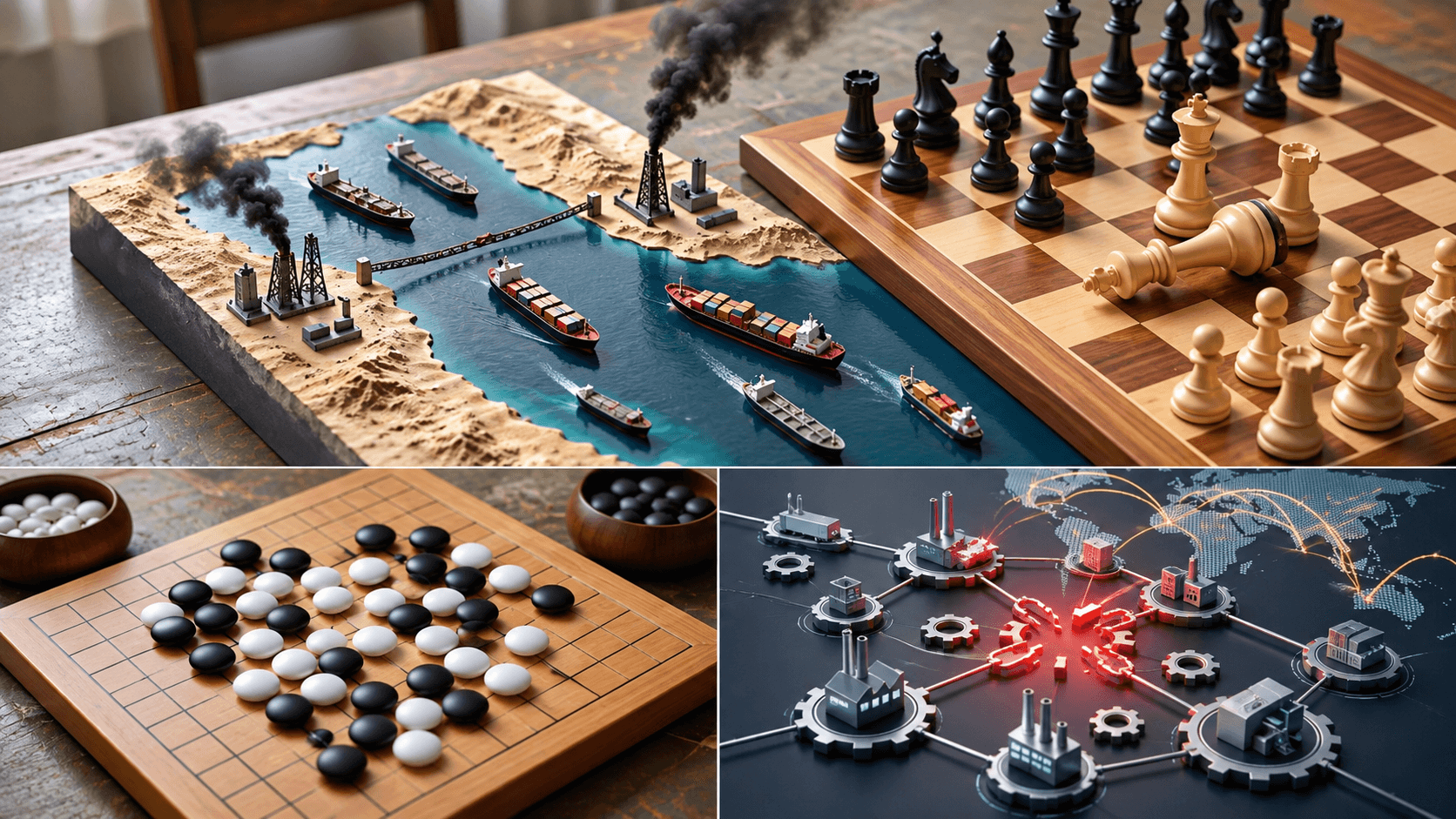
The near-closure of the Strait of Hormuz has become a brutal wake-up call. In a matter of months, a maritime passage thousands of kilometers from Quebec has been enough to disrupt global energy flows, supply chains, and operating costs for countless businesses. Today, visible traffic through the Strait remains only a fraction of its pre-war level.
At Coboom, we see this as a preview of the world ahead. Critical dependencies, geopolitical tensions, energy constraints, and globalized supply chains are making strategies built solely on optimization and growth increasingly fragile.
Two ancient games offer a powerful metaphor for this shift. Chess, likely born in India before spreading westward through Persia and the Muslim world, structures confrontation around capturing pieces and ultimately eliminating the opposing king.
That logic closely resembles the strategy that still dominates business thinking: conquer markets, beat competitors, accelerate, optimize, and maximize performance. In a stable world of abundance, this model delivered spectacular results.
Go, which originated in China thousands of years ago, follows a radically different logic. Players gradually build strong positions, control space, preserve options, and accept the loss of some positions to protect the whole.
That logic is much closer to robustness. The goal is to endure, preserve room to maneuver, and prevent a critical dependency from threatening the entire system.
The current Strait of Hormuz crisis illustrates this logic of indirect pressure. Iran is using restrictions on maritime traffic as a strategic lever while the United States applies military and economic pressure, turning access to one of the world’s most important energy corridors into a geopolitical weapon.
For businesses, the parallel is striking. Continuing to play only chess means pursuing growth, cutting inventories, concentrating suppliers, running assets at maximum capacity, and financing expansion with debt to squeeze out a few more points of performance.
Maximum performance removes exactly the margins needed when the world goes off course. The most optimized companies can quickly become the most vulnerable because they have eliminated the spare capacity, inventories, alternative suppliers, and options they once considered inefficient.
A robust company plays more like Go. It reduces critical dependencies, diversifies supply, maintains excess capacity, keeps options open, and accepts certain short-term costs to preserve its ability to act when a shock hits.
Go also teaches a crucial strategic rule: some positions must be abandoned to preserve the whole. For a business, that means making clear choices about which markets, customers, products, suppliers, and activities to maintain, transform, or abandon before they become structural traps.
The Strait of Hormuz crisis is therefore sending a much deeper signal than a simple rise in energy prices. The rules are changing because the world itself is changing, and a strategy built solely on optimization is becoming a strategy of fragility.
In the world ahead, strategic advantage will belong to businesses that can absorb shocks, preserve room to maneuver, and transform their trajectory before they are forced to. The goal will no longer be only to deliver checkmate. It will be to stay in the game.