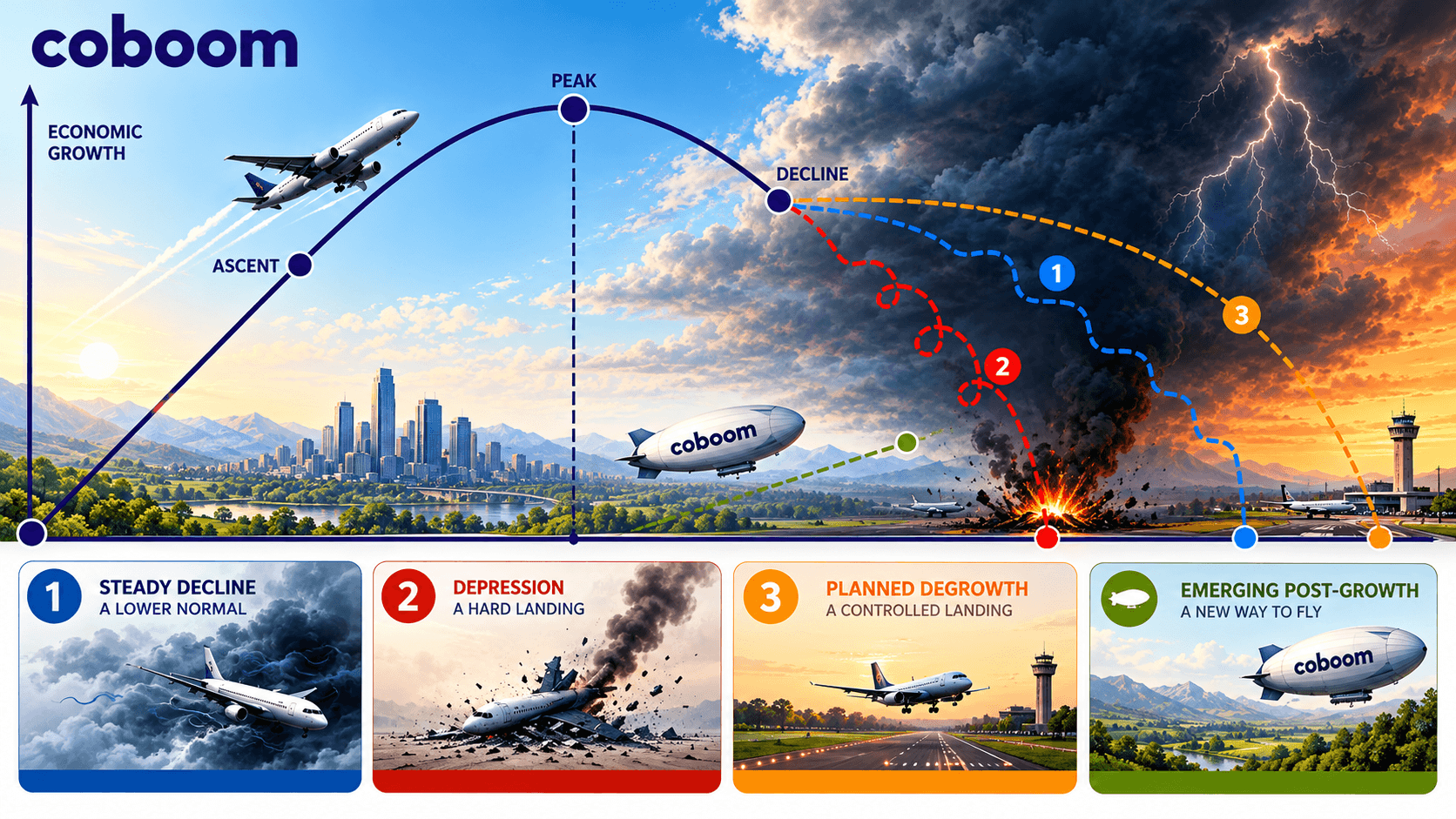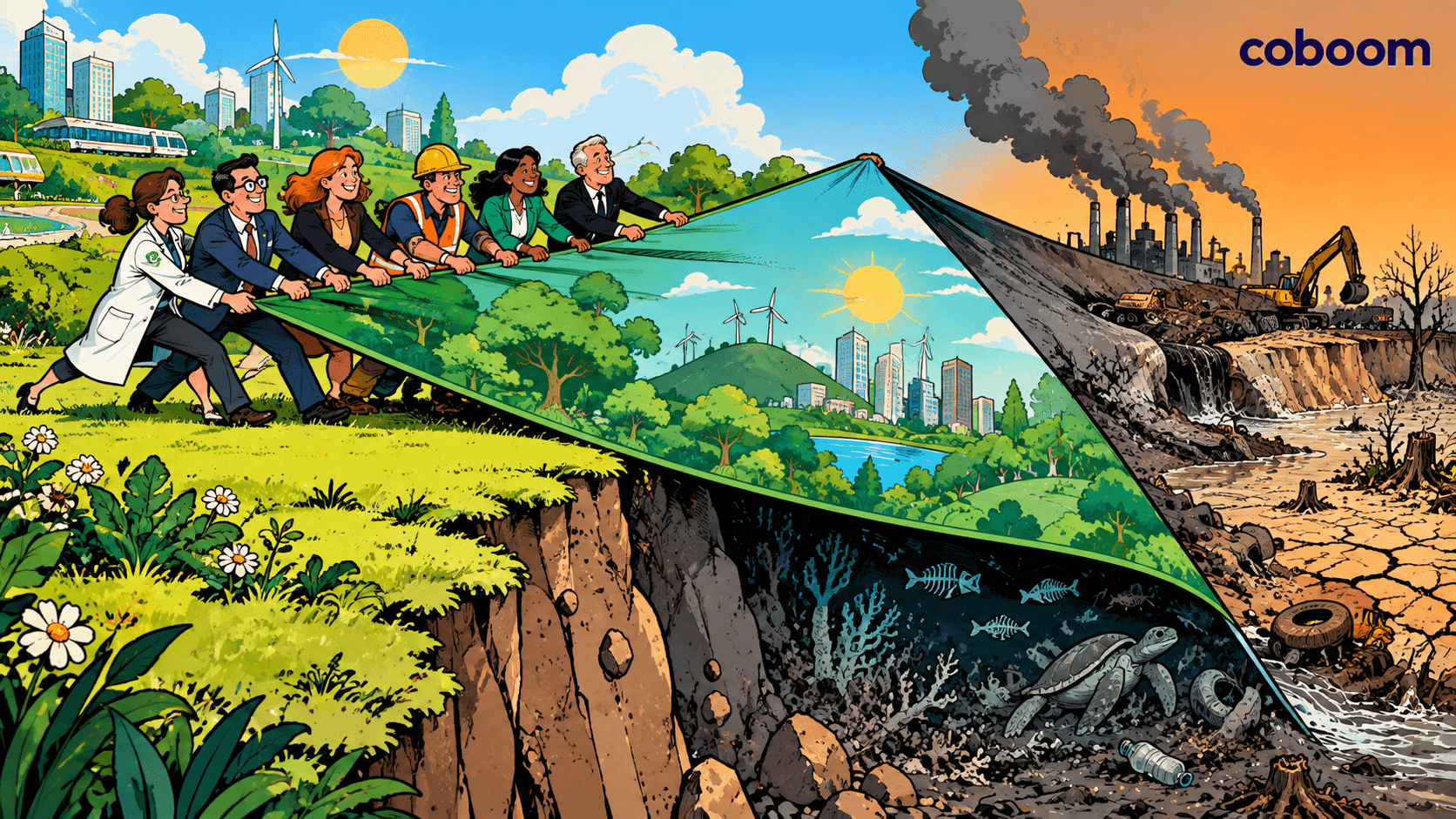
Over the past two weeks, we have shared two analogies to illustrate the dominant economic paradigm: an economy that keeps drawing more heavily on human, natural, financial, and technological resources in order to sustain growth, even as the biosphere that makes that economy possible comes under increasing pressure.
This week, we want to challenge another dominant paradigm: sustainable development. Our criticism is not aimed at the people working sincerely in sustainability, CSR, ESG, green finance, or related fields. It is aimed at the framework of thinking that still shapes much of today’s economic action.
In its dominant form, sustainable development tries to reconcile two objectives that are increasingly difficult to align: sustaining economic growth while simultaneously reducing material and energy throughput enough to remain within the limits of a finite planet. That tension appears even in the United Nations’ Sustainable Development Goal 8, which explicitly calls for “sustained, inclusive and sustainable economic growth” while also seeking to decouple that growth from environmental degradation.
The problem is that global outcomes remain far from that ambition. After more than three decades of climate policy and sustainable development efforts, global CO₂ emissions from fossil fuels reached another record high in 2025. At the same time, the 2025 assessment of planetary boundaries concluded that seven of the nine boundaries have now been exceeded.
This also reveals the limits of siloed approaches. Reducing the ecological challenge to greenhouse gas emissions alone is not enough when the pressures also involve biodiversity, freshwater, land use, nitrogen and phosphorus cycles, chemical pollution, and ocean acidification.
For us, the issue is therefore not a lack of effort. It is the difficulty of questioning the economic framework in which those efforts are being deployed. When sustainable development mainly serves to make an existing model somewhat less harmful without challenging its dependencies, volumes, uses, or purpose, it can end up postponing the harder decisions.
We have entered a different era. Biophysical constraints are no longer an externality that can be dealt with once economic conditions improve. They are becoming structural constraints that businesses, municipalities, and economies will increasingly have to operate within.
The question is therefore no longer simply how to make development “sustainable.” It is what we need to maintain, adapt, develop, and sometimes abandon in order to remain within the limits of the real world.
Our collective responsibility may no longer be to promise a sustainable future, but to build a livable and more robust one.