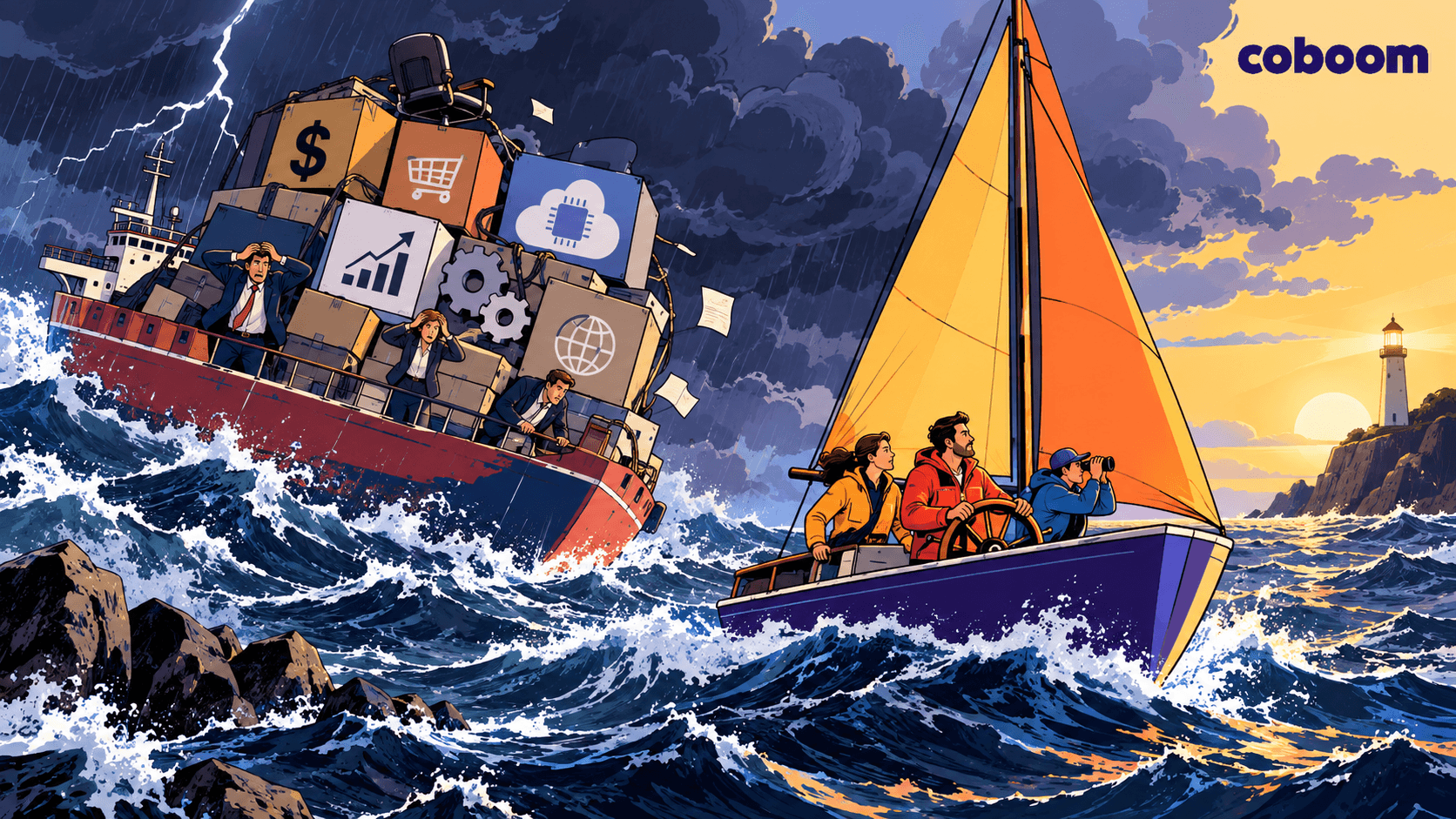
For several months now, we have been speaking with a growing number of business leaders who feel they are navigating without a clear line of sight. The slowdown is setting in, and since Donald Trump’s return to the White House, uncertainty has become a real source of anxiety for many. Margins are shrinking, sales are softening, costs are rising, and supply chains are becoming less predictable. The same question keeps coming up: how do we get through a period this unstable, especially if it lasts?
For years, two mantras have dominated business strategy: grow and modernize. Grow, often at almost any cost, and modernize by adopting the latest technologies, sometimes with borrowed money and without always measuring their true return on investment. That strategy has delivered gains, but in a more unpredictable economy, it can also make companies more fragile. Growing without a margin of safety, taking on debt to keep up with trends, or piling on layers of complexity can reduce the very flexibility businesses need when conditions deteriorate.
We are now seeing that many companies have grown at the expense of their robustness. A critical supplier with no backup. A single export market, such as the United States. A star salesperson who cannot easily be replaced. An exhausted team. Little or no Plan B if conditions worsen. These dependencies may remain invisible when things are going well, but they become critical as soon as a shock hits.
There is still time to change course by putting robustness back at the center of decisions and investments. That means choosing simplicity over complexity, reducing dependencies, and focusing on healthy net profit rather than being satisfied with a flattering EBITDA that can mask the true cost of growth strategies. Charlie Munger, Warren Buffett’s longtime partner at Berkshire Hathaway, was famously critical of EBITDA and once referred to it as “bullshit earnings.”
Every year, we speak with hundreds of business leaders. When we ask them to describe their company, most begin with revenue and headcount. Far fewer start with net profit. Yet net profit is one of the clearest indicators of a company’s ability to absorb shocks, invest, reduce dependencies, and preserve room to manoeuvre. High revenue without solid net profit or a margin of safety can simply mean greater exposure when conditions change.
A global economic slowdown could add to that pressure in the months ahead, particularly as trade tensions, high debt levels, and an already fragile global economy reinforce one another. In that environment, economic Darwinism will do its work: some companies will disappear, others will adapt, and a few will emerge stronger.
The most robust companies won’t necessarily have the highest revenue, the largest workforce, or the most advanced technology. They’ll be the ones that have kept enough room to manoeuvre to absorb shocks, adapt quickly, and continue creating value when conditions get tougher.