We are entering a period in which business development can no longer be approached the way it was in the past. Announcements about the possibility of artificial general intelligence, with learning and reasoning capabilities comparable to those of humans, are becoming more frequent. At the same time, the metacrisis is reshaping the foundations of the economy: climate change, biodiversity loss, resource scarcity, high public and private debt, geopolitical tensions, and growing military conflict.
In this environment, not all economic activities will be exposed in the same way. To think more clearly about what comes next, we can group them into three broad categories: physical activities, hybrid activities, and knowledge-based activities.
Physical activities such as agriculture, construction, and manufacturing could become even more essential in the decades ahead. Many of these activities remain difficult to fully automate because they take place in variable environments and require constant interaction with the physical world. Feeding, housing, making, transporting, maintaining, and repairing will remain fundamental functions regardless of how technology evolves.
Hybrid activities such as healthcare, education, community services, and personal care combine knowledge, human relationships, and hands-on intervention. Their proximity to basic human needs, their local roots, and their relational nature make them generally harder to offshore and more difficult to automate completely. They also play a central role in social cohesion and the functioning of our communities.
Knowledge-based activities such as finance, professional services, certain administrative functions, and communications may be more exposed to two pressures at once: accelerated automation through AI and a potential decline in the net energy available to support an increasingly complex economy.
For several decades, the expansion of knowledge-based activities was made possible in part by abundant and relatively inexpensive energy. Energy Return on Investment, or EROI, helps measure this reality by comparing the energy produced with the energy required to produce it. The higher the EROI, the more surplus energy a society has available to support activities beyond its basic needs. As that surplus declines, economic trade-offs become more significant.
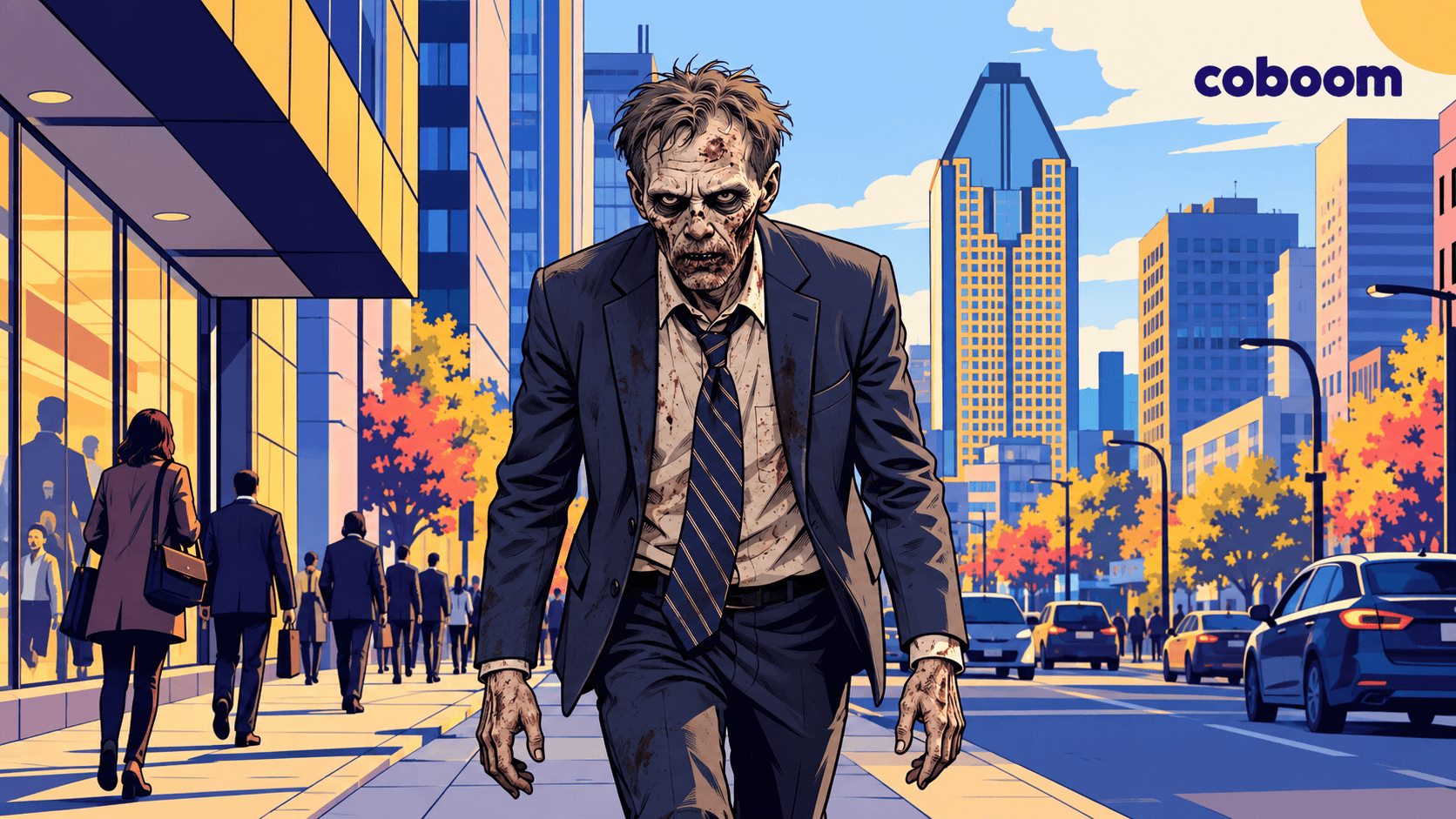
This is the context in which we see the emergence of products, services, and activities we call “Zombies.” They may still look viable today, and some may even appear highly promising, but major long-term trends are already weakening their usefulness, profitability, or ability to remain relevant by 2040. Rapid advances in AI, energy constraints, resource scarcity, and the broader metacrisis could accelerate that trajectory.
Foresight is precisely about looking beyond current performance to understand what may still create value tomorrow. An activity that is profitable today is not necessarily robust over the next 15 years, just as an activity that is undervalued today may become strategic when conditions change.
The question is therefore unavoidable: are your company, your products, your services, and the skills they depend on rooted mainly in a reality inherited from the past, or in needs that will still matter tomorrow? Are they “Zombies,” or are they truly built for the future?